
Ditch the Myth: Your $10,000 Peptide Stack Delivers More Hype Than Evidence
⚠️ Medical Disclaimer: Peptides can interact with medications, worsen medical conditions, or cause dangerous infections when sourced from unregulated vendors. Always consult your physician to discuss your personal case before starting any peptide or supplement.
Athlete Warning: Many peptides—including BPC-157—are banned by WADA/USADA. A single positive test can end a competitive career.
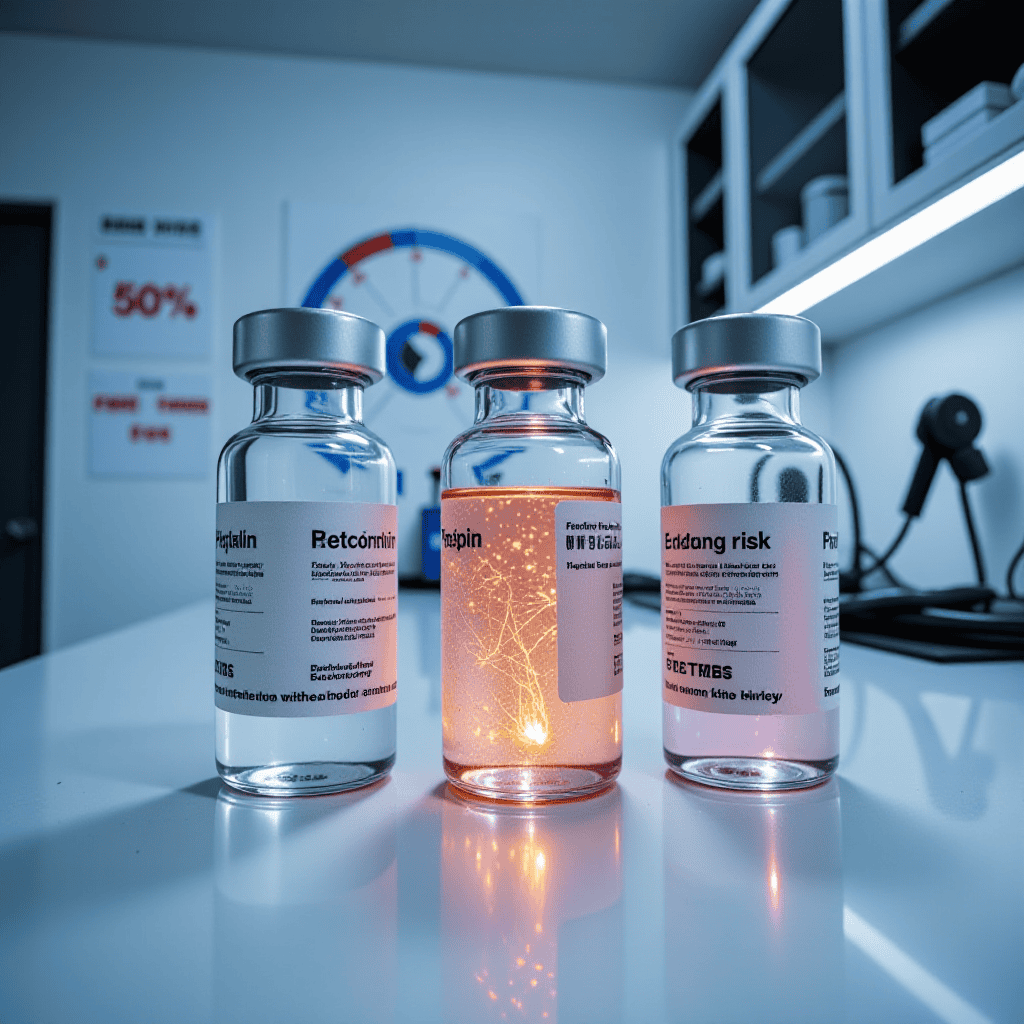
The Seduction: $10,000/year Peptide Stacks, “Biohacking,” and Irresistible Before/After Photos
From Instagram clinics to concierge peptide coaches, the industry is booming — projected to hit $5–7 billion globally by 2028, driven heavily by influencer marketing and direct-to-consumer telehealth ads. You’ve seen the reels: shredded 8-week transformations, glowing skin, perfect sleep, unlimited energy. But what you rarely see are purity reports, clinical trial data, or FDA oversight.
FDA Crackdown (2023–2025): The Market Collapsed Into Gray-Zone Vendors
Between 2023 and 2025, the FDA removed most reputable 503B outsourcing pharmacies from compounding popular peptides like CJC-1295, Ipamorelin, and BPC-157. What filled the vacuum? Overseas raw powder suppliers and hundreds of new “research chemical” websites.
According to Reuters, the FDA seized thousands of counterfeit GLP-1 products, stating: “Counterfeit Ozempic contained no active ingredient and tested positive for bacterial endotoxin.” Hundreds of fake online profiles and ads were identified during these investigations.
Hype vs Evidence: What the Science Actually Shows
To keep this grounded, here’s a table comparing popular peptide claims with what human clinical research actually supports:
| Peptide | Hype Claims | Evidence Reality |
|---|---|---|
| BPC-157 | Rapid healing, tendon repair, gut repair | Strong preclinical data; very limited human RCTs. Banned by WADA (2022) and under FDA review for safety/immune risks. |
| CJC-1295/Ipamorelin | Growth hormone boost, fat loss, muscle gain | Minimal high-quality human data. FDA removed them from compounding. May suppress natural GH pulsatility long-term. |
| Collagen Peptides | Perfect skin, reversed aging | Meta-analysis: modest improvements in hydration and elasticity (SMD 0.5–0.8). Real but not dramatic. |
| TB-500 (Thymosin Beta-4) | Muscle healing, injury prevention | Almost entirely animal studies; no robust human trials. |
| GLP-1RA (Semaglutide/Tirzepatide) | Fast, effortless fat loss | FDA-approved with excellent RCT data. Shortages and counterfeits common. See our full guide here. |
Quality Crisis: Many Peptide Vials Are Contaminated or Under-Dosed
Independent U.S. lab testing often finds:
• Less than 50% of labeled dose
• Bacterial endotoxin contamination (can cause sepsis-like reactions)
• Solvents or heavy metals
• Incorrect or substituted peptide sequences
The FDA reported multiple seizures (2024–2025) where counterfeit Ozempic and semaglutide products contained zero active ingredient and tested positive for endotoxin. Several patients required hospitalization.
Peptides With Strong Human Evidence (The Short List)
Only a few peptides have real RCT-level validation:
Semaglutide and Tirzepatide — gold-standard weight-loss data (10–22% bodyweight reduction).
Teriparatide — FDA-approved for osteoporosis.
Collagen Peptides — modest, measurable benefit for skin hydration (SMD 0.5–0.8).
Insulin, GLP-1s, GH, etc. — but these are hormones, not typical “biohacker peptides.”
Everything else? Mostly animal data, mechanistic theory, or anecdotal claims.
If You Insist on Using Peptides Anyway: Harm-Reduction Guide
1. Request third-party COA (HPLC, MS, endotoxin testing). If none — walk away.
2. Avoid overseas “research chemical” sites.
3. Never inject cloudy or particulate solutions.
4. Start with one peptide at a time; avoid stacks.
5. Cycle off every 4–8 weeks to evaluate tolerance.
6. Avoid auto-renew subscriptions.
7. Stop immediately with fever, redness, tachycardia, or GI distress.
Red Flags for Scams
• “Human-grade” claims without COA
• No address or pharmacy license on website
• Unrealistic before/after images
• Pressure for auto-renew
• Claims of “FDA-registered peptides” (not a real designation)
• Social media DMs offering “wholesale prices”
Internal Resources to Explore
• Learn how real GLP-1 medications work: Semaglutide & Tirzepatide Guide
• Evidence-based muscle performance guide: Creatine Supplementation
• Immune health breakdown: Vitamin C Myth Article
Conclusion: The Industry Is Loud — The Science Is Quiet
Peptides remain one of the most over-marketed and under-studied areas of modern wellness. A few are legitimate medical therapies. Most are sold in a regulatory gray zone, with questionable purity and very limited human data.
If you’ve experimented with peptides, share your experience below — what worked, what didn’t, and what surprised you?
References
Reuters. “U.S. FDA Warns Online Vendors Selling Unapproved Weight-Loss Drugs.” December 17, 2024.
Table of Contents
Is peptide stacking a myth, or does combining peptides actually work?
Peptide stacking is not a complete myth, but the evidence behind most combinations is extremely limited. Almost all “stacking benefits” come from animal studies, small pilot trials, or anecdotal reports. There are no large, well-controlled human trials showing that stacking multiple peptides provides better results than using a single, clinically studied therapy.
Speak to your doctor to discuss your personal case.
Is peptide stacking safe, especially since some peptides aren’t FDA-approved?
Stacking increases risk because most peptides sold online are not FDA-approved, not quality-regulated, and may contain impurities or incorrect dosages. Combining multiple unregulated compounds can raise the chance of infection, hormonal disruption, fatigue, GI symptoms, or unexpected drug interactions.
Speak to your doctor to discuss your personal case.
Are peptide stacks only for bodybuilders and elite athletes?
No. Many people outside of bodybuilding experiment with peptides for sleep, skin health, weight loss, or injury recovery. However, most of these peptides lack strong human research, and several — including BPC-157 and TB-500 — are banned by WADA and USADA, meaning athletes cannot use them safely without risking a positive test.
Speak to your doctor to discuss your personal case.
Can all peptides in a stack be mixed into one vial or syringe, or can this cause degradation or reduced effectiveness?
Mixing multiple peptides in one syringe can cause chemical instability, pH changes, precipitation, or loss of potency. Most peptides have different solubility, acidity, and storage requirements. Without validated compatibility data — which almost never exists — mixing them increases the chance of degradation or contamination.
Speak to your doctor to discuss your personal case.
Is combining multiple peptides as safe as using a single therapy, or does stacking increase the risk of side effects?
Stacking generally increases risk because you’re adding more variables: more biologic activity, more unknown interactions, more injection exposure, and more chances for impurities. Many users report fatigue, headaches, bloating, or hormonal shifts when combining growth-hormone–modulating peptides. In contrast, single therapies with strong research (such as GLP-1 medications) have well-defined safety profiles.
Speak to your doctor to discuss your personal case.

Life in Balance MD is led by Dr. Amine Segueni, a board-certified physician dedicated to delivering clear, evidence-based health insights. His passion is helping readers separate facts from myths to make smarter, healthier choices. Content is for educational purposes only and not a substitute for medical advice.
- Amine Segueni, MD

- Amine Segueni, MD
- Amine Segueni, MD

- Amine Segueni, MD

“Great article! It really highlights the risks and lack of evidence behind many peptide stacks. I’m particularly curious about BPC-157, which you mention has strong preclinical data but limited human RCTs. I recently came across this detailed analysis of BPC-157 and KPV peptides for MCAS (Mast Cell Activation Syndrome) at https://mindbodyneurology.com/bpc-157-and-kpv_peptides-for-mcas/. Have you seen any clinical data or patient reports suggesting BPC-157 could be beneficial for MCAS, or is this another area where the hype outweighs the evidence? Would love to hear your thoughts!”